
TANGIBLE VET TECH
The Belka Series - Denver, Co.
A less invasive way to fix a failing heart valve in dogs.
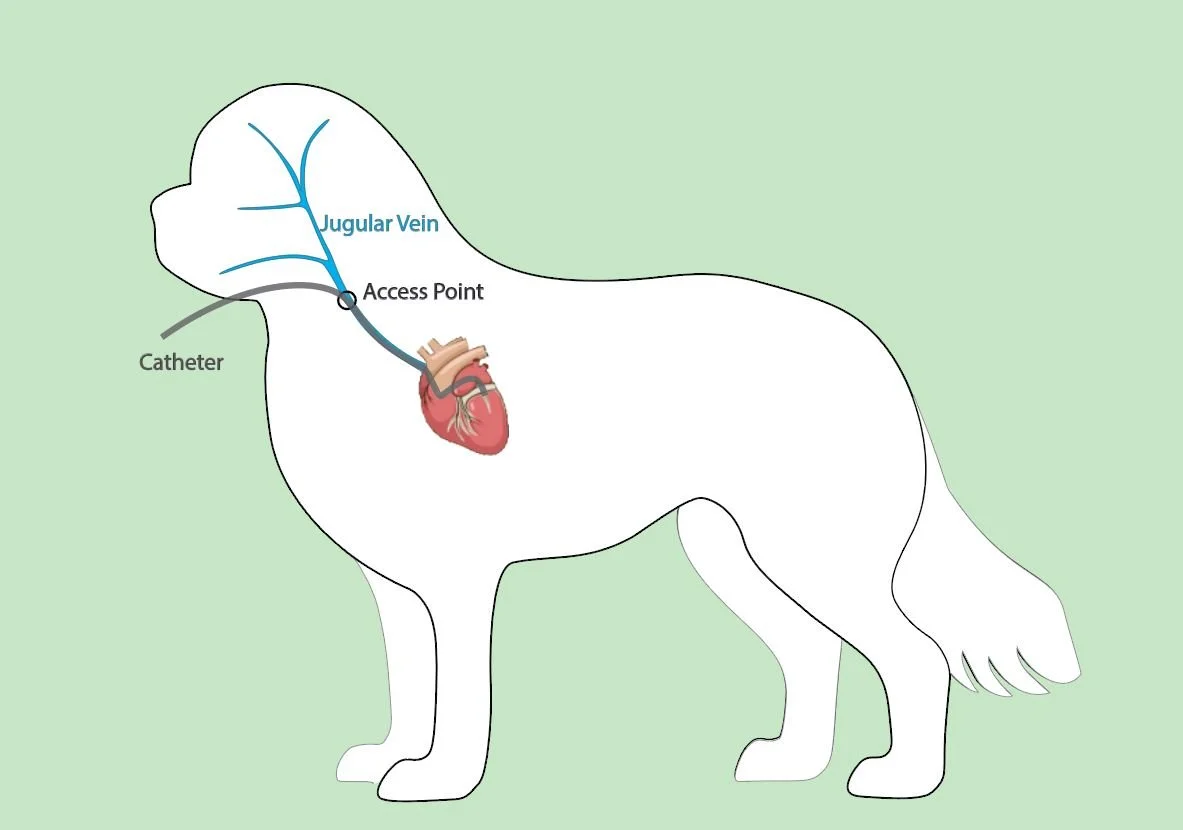
We're developing the first fully transvenous mitral valve repair system designed specifically for dogs — delivered through the jugular vein, on a beating heart, without opening the chest.
10%
of all dogs develop
mitral valve disease
85%
of small breeds
affected by age 13
$40K+
cost of open-heart surgery, if available
~8
Approximately 8 centers perform TEER worldwide
——-THE CHALLENGE
An impossible choice for millions of families
The disease
Myxomatous mitral valve disease (MMVD) is the most common heart condition in dogs. The mitral valve degenerates, causing it to leak. The heart works harder to compensate — eventually leading to fatigue, coughing, difficulty breathing, and heart failure.
Medications manage symptoms but cannot repair the valve. For most dogs, the disease is progressive and there is no fix.
Current options
Medication - Manages symptoms but doesn't address the root cause. Dogs remain on escalating drug regimens for life.
Open-heart surgery - Effective but requires bypass, costs $30-50K, and is available at fewer than five centers worldwide.
Transapical TEER (V-Clamp) - Less invasive, but still requires a chest incision and full OR. Limited to a handful of academic centers.
——- OUR SOLUTION
Repair the valve Without opening the chest
The Belka Series is a transcatheter edge-to-edge repair (TEER) system designed from the ground up for canine anatomy.
Catheter Access
A small catheter enters through the jugular vein, no chest incision, no rib spreading, minimal trauma
Image Guided Navigation
The catheter is guided to the heart under real-time imaging, using techniques already familiar to veterinary cardiologists.
Clip Deployment
A purpose-built clip brings the mitral valve leaflets together, reducing the leak. The heart continues beating throughout.
Patient-Specific Design
Every device is designed using the patient's own imaging data and fabricated with voxel-level 3D printing for an optimal anatomical fit.
——- HOW WE COMPARE
A new category of treatment
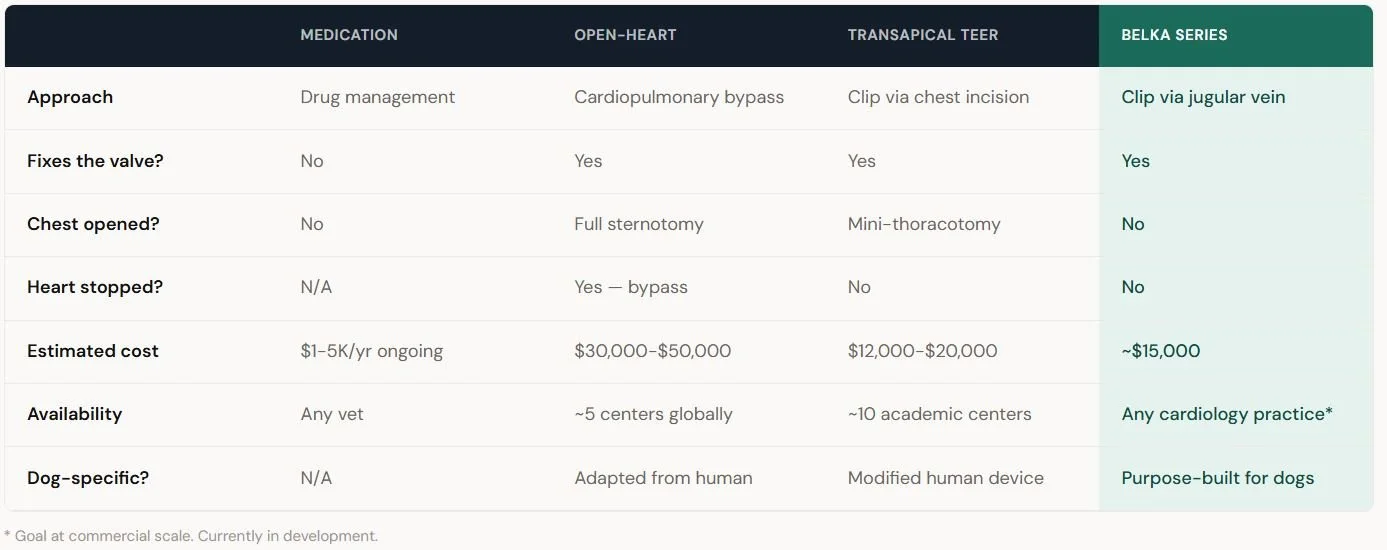
Understanding where the Belka Series fits relative to existing options.
——- OUR TEAM
Built by the people who pioneered this field
Clinical leadership, engineering innovation, and operational execution — the combination required to bring this to market.
BS
Brian Scansen, DVM, DACVIM
Clinical Advisor & Board Member
Pioneer of transcatheter cardiac intervention in dogs. Led the pivotal V-Clamp TEER study (96% procedural feasibility). Trained every major U.S. TEER program. Faculty, Colorado State University.
NJ
Nicholas Jacobson
Co-Founder & CTO
Harvard GSD. Anschutz Medical Campus. Created the DICOM-to-print workflow enabling patient-specific device design. Over 30 publications. Nearly a decade developing voxel-level fabrication.
JL
Jordan Lewis
Co-Founder & CEO
Leads fundraising, partnerships, and commercialization. Driving the Belka Series from concept through clinical trials, with focus on strategic partners including Mars Veterinary Health.
——- DEVELOPMENT ROADMAP
From concept to clinical reality

Clinical leadership, engineering innovation, and operational execution — the combination required to bring this to market.
Technology Platform Developed
Proprietary DICOM-to-device workflow validated. Voxel-level 3D printing for patient-specific implant design.
COMPLETED
Clinical Advisory Board Formed
Dr. Brian Scansen joined as clinical advisor and board member.
COMPLETED
Market Research & IP
250+ owner surveys. Patent applications filed with 46 claims covering manufacturing methods and delivery systems.
COMPLETED
Bench Testing & Cadaver Studies
Device iteration. Delivery system validation. Procedural workflow development with veterinary cardiologists.
IN PROGRESS
First-in-Dog Clinical Series
Initial cases in client-owned dogs. Target: procedural feasibility and acute safety.
PLANNED
Multi-Center Expansion
Training and deployment across specialty cardiology practices nationwide.
PLANNED
——- OWNER RESEARCH
250+ dog owners have shared their experience.
Your firsthand experience with mitral valve disease shapes our clinical development. The survey takes ~10 minutes and directly influences how we build the Belka Series.
80% never told by their vet that a surgical option existed
90% would consider a less invasive treatment option
79% expressed interest in clinical trial participation
Why "Belka"?
In 1960, a small dog named Belka became one of the first living creatures to orbit the Earth and return safely. She proved that what seemed impossible was within reach. We named our device series after her — because we believe the same is true for dogs with heart disease.